What works
Updated November 3, 2026: most features that were Mac only when this post came out have since been ported, so these lists describe the app as it is now.
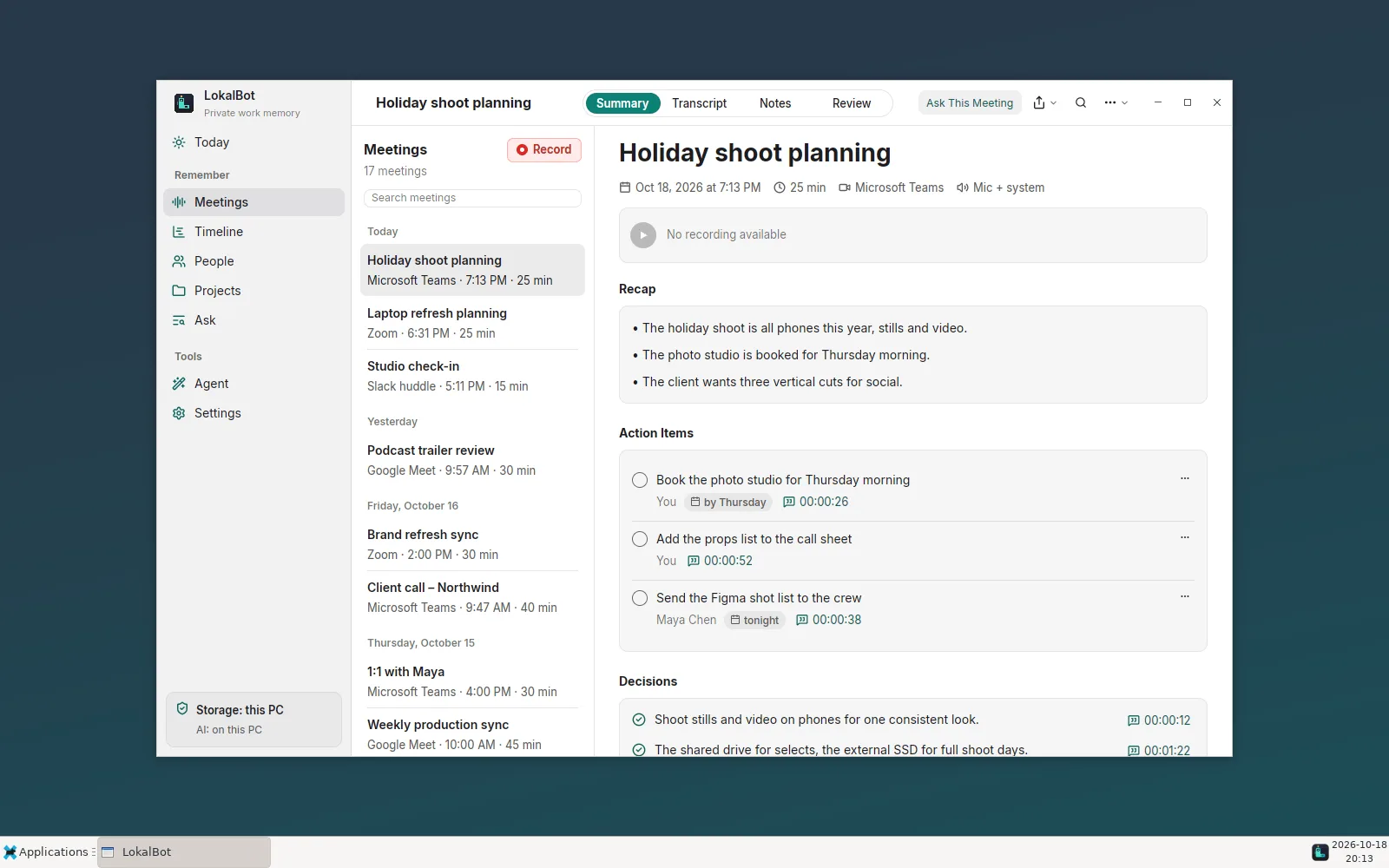
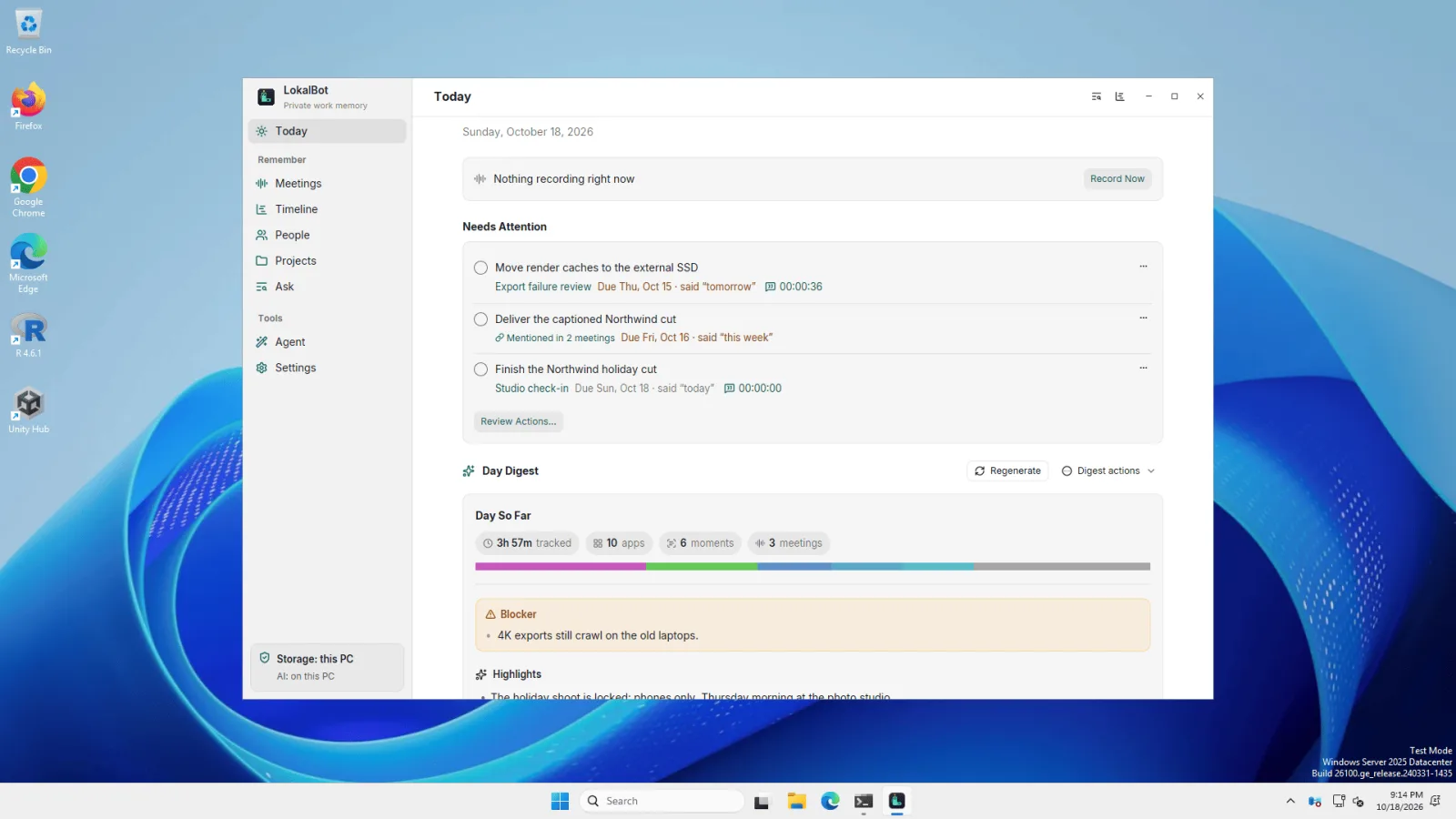
The Windows and Linux app is written in Rust with GPUI, the UI framework behind the Zed editor. Meetings, transcription, Ask, search, day memory, screen context, dictation, autocomplete, selection actions, spoken summaries, Files, overnight review, Personal Context, meeting note and daily exports, calendar, Agent Mode, and the CLI and MCP server for coding agents all work. Like the Mac app, it runs its models on your computer by default, and it has no account and no telemetry.
What's still missing
- The Windows build isn't code-signed yet. SmartScreen asks before the first launch: choose More info → Run anyway.
- Wayland support is partial. Autocomplete in other apps works as an input method on Sway, Hyprland, GNOME, where you also add LokalBot as an input source, and, since 0.12.3, KDE Plasma, where you choose it under Virtual Keyboard. It has only been tried on headless Sway, GNOME, and KWin with stand-in suggestions, and Hyprland itself hasn't been run (how it works). On other compositors it works in the practice editor in Settings. For dictation and selection actions on Wayland, bind
lokalbot dictateandlokalbot selection-actionsto shortcuts in your desktop's settings. - Meeting audio isn't always one app's. On Windows and Linux LokalBot records the meeting app alone where it can be separated, and otherwise everything the computer plays.
- Remembered speakers only suggest. Later meetings offer a remembered name for you to apply, rather than naming the speaker automatically as on Mac.
- No iPhone or iPad app yet. Android phones and tablets pair with Windows and Linux as they do with a Mac, through the app on Google Play, but the iPhone and iPad app isn't in the App Store yet.
- A few features are Mac-only for now: Gmail in meeting briefs, Apple Intelligence, Granite Speech transcription, and Nemotron speaker separation.
The full list is in what works where, and the two-page overview shows what changed.
The models
- Transcription: Qwen3-ASR 0.6B through sherpa-onnx, with Parakeet v3 and v2, SenseVoice, GigaAM for Russian, and Whisper turbo as options.
- Speaker separation: pyannote segmentation and TitaNet.
- Notes and Ask: Qwen3.5 4B, the same as on Mac.
- Search: EmbeddingGemma 2, the same as on Mac.
- Autocomplete: LFM2.5 1.2B.
The default download is about 4 GB. llama.cpp runs on a Vulkan GPU or the CPU, and since 0.11.3 you can choose CUDA (experimental) in Settings → Models → llama.cpp on a supported NVIDIA GPU. You can swap any model in Settings.
Install
- Windows 10 or 11, x64: run
LokalBot-<version>-windows-x86_64-setup.exefrom the latest release. It installs for your user, without administrator rights. A portable zip is in the same release. - Linux x86_64: install the
.deb(Debian, Ubuntu), the.rpm(Fedora, openSUSE), or the Arch package, or extract the.tar.gzand run./install.sh. Since 0.11.2 the.deb, and the.rpmon Fedora, add the LokalBot repository, sosudo apt upgradeorsudo dnf upgradebrings later versions.
Linux needs glibc 2.39 or later (Ubuntu 24.04, Debian 13, Fedora 40, or newer), PulseAudio or PipeWire, and a Vulkan or OpenGL driver. See the system requirements.
On Omarchy and other Hyprland desktops
Omarchy already has everything LokalBot uses on Wayland: grim for screen context, wtype and wl-clipboard for dictation, PipeWire for meeting audio, and the Hyprland desktop portal. Install the Arch package with sudo pacman -U, then bind LokalBot's commands in ~/.config/hypr/bindings.lua. These keys are free in Omarchy's defaults:
o.bind("SUPER + ALT + D", "LokalBot dictation", "lokalbot dictate")
o.bind("SUPER + ALT + A", "Ask LokalBot", "lokalbot quick-recall")
The tray icon appears in Omarchy's bar, and the dictation pill and Quick Recall float instead of tiling.
Omarchy runs Fcitx 5 for typing other languages, and a desktop runs one input method at a time, so autocomplete in other apps stays out of its way and Settings says so. If you don't use Fcitx 5, systemctl --user disable --now omarchy-fcitx5.service lets autocomplete start. This comes from reading Omarchy's repository; it hasn't been tried on Omarchy.
Tell us what breaks
Most testing so far has been on a handful of personal and rented machines, so reports from real hardware help the most. Open an issue with your distribution, desktop, X11 or Wayland, CPU and GPU, and what you tried.